2011年12月27日火曜日

Variety of Clocks

This is the second article.

The title is "Variety of Clocks".
In this article, I will introduce you many kinds of clocks.


At first, I will list as many types of clocks as I can remember on my own.

sundial, water clock, sandglass, candle clock
     ---these are the clocks that I mentioned in the last article.

Others...hmm....

watch, wall clock, desk clock.....

Maybe this is my limitation, so, I will do research on the Internet.
I will pick out some interesting/funny ones and list them below.


pocket watch (see the right picture)
: This type of watch is made to be carried in a pocket. The White Rabbit, who is a character of "Alice's Adventures in Wonderland", has pocket watch, too.

alarm clock
: I think everyone knows this clock. More over, I'm sure everyone uses this everyday!

marionette clock/carillon clock
: At every fixed time, the dial plate and dolls move with melody/chime. Example: cuckoo clock
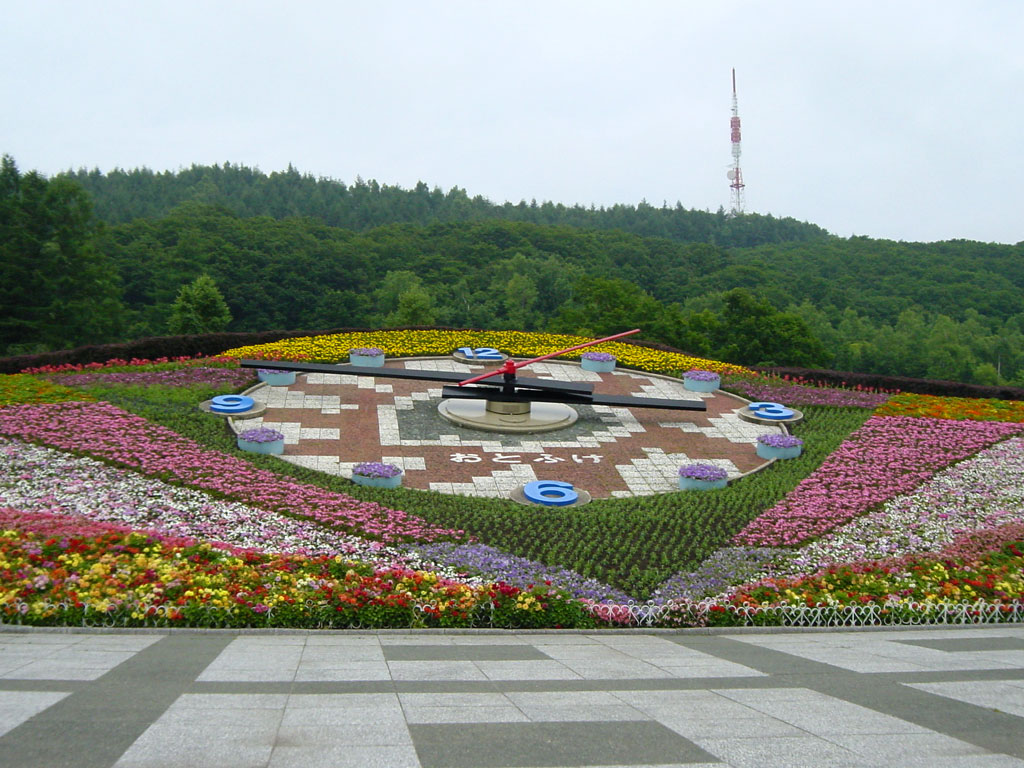

floral clock (see the right picture)
is a large decorative clock set into a flower bed in a park or other public recreation area. (Wikipedia)


chess timer
: This is a kind of timer. When we are playing shogi, go, or chess, it shows the opponent's time limit.


stopwatch
: This is portable time counter. Some have the function of showing the time.


world time keeping instrument
: This type of clock shows every part of world's standard time.


barber clock (see the right picture)
: This type of clock is made to be seen through a mirror. The hands spin in the opposite way and the numeric characters are mirror writing .


stomach clock / tummy clock (see the following picture)
:  When a creature becomes hungry, his stomach tells that it is time to eat. This is not actually a mechanical or electric clock, though. We can buy it nowhere, but no one doesn't have this clock.


There are so many kinds of clocks.
I'm astonished that timer and stopwatch are also a kind of clocks...

2011年12月26日月曜日

History of Clocks

Hi, this is Moe.

My blog's theme is...


CLOCK / WATCH !!!


I like them very much but I think I don't know much about them...

So, I will write this blog after some research every time.

I'm looking forward to knowing much more about clocks or watches,
and hope you have the same experience :)


So, this is the first article, the title is "History of Clocks",
 I will write brief history of clocks since it started from twentieth century B.C.


The history could be divided into three parts.

<before mechanical clock>, <mechanical clock>, <electric clock>.

Let's start from before mechanical clock  era.


<before mechanical clock >---from 2000 B.C. to around 700 A.D.
In this era, some types of clocks were invented.

sundial (see the picture on the right)
: This is the oldest type of clock. People knew time from shadow, but its weak point was that it only could be used in the sunny daytime.

water clock
: People knew time from how much water flowed. This clock can be used in non-sunny daytime and nighttime, too. But it still has a weak point: being subject to climate. That is, when it is cold, water turns into ice, and when it is hot, water evaporates. These makes it impossible to show exact time.

sandglass
: This type of clocks can be seen in modern life, too. The difference is that it is made for longer time; like thirty minutes, an hour, three hours, etc. Its weak point is that the person who must turn upside down might sleep, or feel tiresome and do it before the all sand falls.

candle clock
: People knew how much time had passed from the length of burning candle. Fuse and stick of incense are also used.


These are kind of primitive clocks, so to speak.
Let's check the advance!


<mechanical clock>---from around 1300s to 1913
In this era, clocks' source of power is flat spiral springs or weight.

Explaining the mechanism of these clocks is too difficult for me, so I will introduce a man who contributed to clock's history, instead.

His name is Christiaan Huygens.
He was a prominent Dutch mathematician, astronomer, physicist and horologist.
He invented pendulum clock in 1656.
Nine years later, he invented a clock equipped with flat spiral springs.
This is said to be the first practical mechanical clock in the world.


<electric clock>---1918~
In this era, more advanced clocks were invented.

The mechanism of clocks in this era is also too difficult for me to explain.
But, what I can state is that clocks are more advanced; from coming to use batteries to timing by using spectral line of atoms (these clocks are called "atomic clock").


From sundial to atomic clock, human made a big progress through thousands of years.
Many clocks timed such a vast time throughout the history.... so magnificent.